
Multiple samples in one cytome
The multi-sample tutorial concatenates AnnData objects in memory. This does the same analysis with the samples merged into one cytome on disk, which is the version that keeps working when the samples stop fitting in RAM.
Nothing about the method changes. What changes is where the matrix lives.
1. One cytome per sample
load_dataset writes a cytome directly — the registry entries are 10x .h5
files and cytome reads that format, so there is no AnnData in this step:
import cytome, piaso
parts = []for name in ("pbmc_multiome_san1", "pbmc_multiome_san2"):    piaso.data.load_dataset(name, return_type="cytome",                            cytome_path=f"{name}.cytome").close()    parts.append(f"{name}.cytome")
Converting per sample rather than concatenating first is the point: each file is read, written and closed one at a time, so peak memory is one sample rather than all of them.
One call per file, for now.
cytome.from_10x_h5takes a single path andcytome.mergetakes cytomes, so importing several.h5files in one streaming pass is not available yet. It would be a convenience rather than a memory win — the two-step route above is already bounded, because neither step holds more than one sample.
2. Merge
ds = cytome.merge(parts, output="pbmc_merged.cytome",                  batch_key="sample", batch_labels=["SAN1", "SAN2"],                  gene_strategy="inner")
ds.n_cells, ds.n_genes          # 7905, 36601
Close what merge returns. It hands back an open CytomeDataset, and a
second connection to the same file then hits
sqlite3.OperationalError: database is locked on the first write — which
surfaces several steps later, inside infog, pointing at nothing useful.
batch_labels writes the sample name into ds.cells["sample"], so provenance
travels with the cells instead of living in a variable you have to remember.
gene_strategy="inner" keeps genes present in both; "union" keeps everything
and zero-fills, which is right when the panels genuinely differ and wrong when
one sample simply failed to detect a gene.
Barcodes collide across libraries — the same sequence means different cells —
and merge disambiguates them, which is the same problem index_unique solves
on the AnnData side.
3. Normalise, embed, cluster
Everything below takes the open dataset. There is no reopening and no
flushing by hand: infog persists its own writes, and runGDR accepts a
cytome object as readily as a path.
piaso.tl.infog(ds, modality="RNA", layer="counts",               key_added="infog", save_layer=True, inplace=True)
piaso.tl.runGDR(ds, batch_key="sample", groupby=None,                layer="infog", score_layer="infog", max_workers=8)
piaso.tl.neighbors(ds, use_rep="X_gdr", n_neighbors=15)piaso.tl.umap(ds, key_added="X_umap")piaso.tl.leiden(ds, resolution=1.0, key_added="leiden")
batch_key="sample" is the whole difference from a single-sample run: GDR
finds marker genes within each library and scores every cell against all of
them, so an axis means the same thing in both samples. groupby=None because
these libraries have no annotation yet — GDR clusters within each batch and
uses what it finds.
| step | time |
|---|---|
| convert both samples | 22 s |
| merge | 16 s |
| INFOG | 4 s |
runGDR (batch_key="sample") | 32 s |
| neighbours + UMAP + Leiden | 14 s |
4. Read it the same way
piaso.pl.plotEmbedding(ds, color="sample", basis="X_umap")piaso.pl.plotEmbedding(ds, color="leiden", basis="X_umap", legend_loc=None)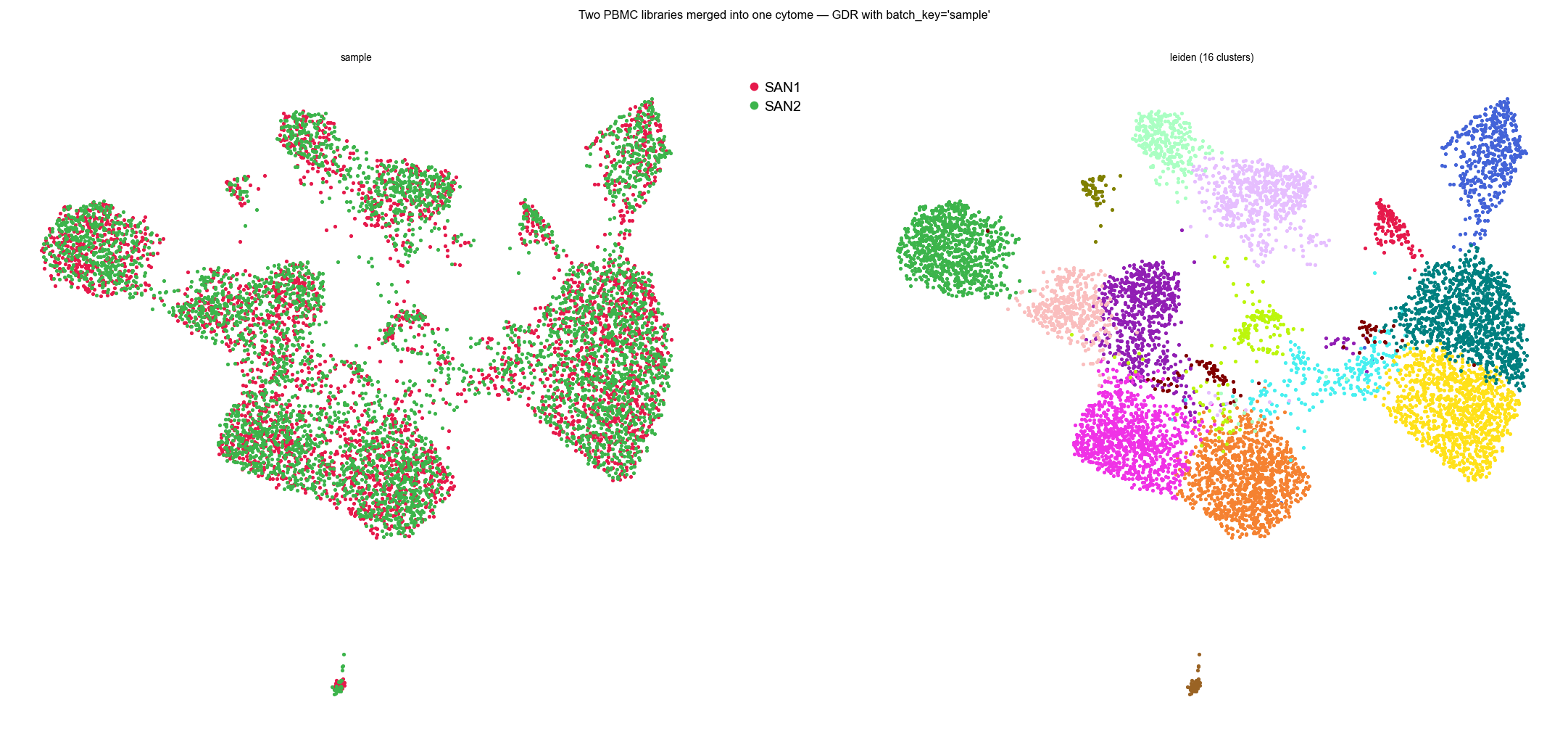
Both panels, again, because either alone is unreadable as evidence. By sample, SAN1 and SAN2 interleave through every population rather than forming two islands. By cluster, 16 clusters resolve on the same points. Batch mixed, biology separated — the same check as every other integration on this site.
Which route to use
| AnnData | cytome (this page) | |
|---|---|---|
| samples in memory | all, concatenated | one at a time, then none |
| provenance | obs["sample"] you set | batch_labels written at merge |
| barcode collisions | index_unique="-" | handled by merge |
| scales to | what fits in RAM | what fits on disk |
At two PBMC libraries the AnnData route is simpler and there is no reason to avoid it. The cytome route earns its keep at the point where concatenating would not finish — and the analysis code above is unchanged from that point on, which is the argument for learning it before you need it.